

Horse dentistry, also known as equine dentistry, is an important part of maintaining a horse’s overall health, comfort, and performance. Because horses have a unique dental structure and spend much of their day chewing forage, their teeth experience significant wear throughout their lives. Regular dental examinations can help identify problems early, improve a horse’s ability to eat efficiently, and prevent dental conditions from becoming painful or serious.
Unlike human teeth, a horse’s teeth are designed to gradually erupt throughout much of the animal’s life. This continual eruption helps compensate for the natural wear caused by chewing grass, hay, and other fibrous foods. However, the teeth do not always wear evenly. When uneven wear occurs, sharp edges, hooks, points, and other abnormalities can develop.
Understanding how equine dentistry works and recognizing the signs of dental problems can help horse owners provide better long-term care.
Why Horse Dentistry Is Important
A horse relies heavily on its teeth to break down food before swallowing. Horses chew forage by moving their jaws in a grinding motion that crushes grass and hay into smaller particles. When the teeth become painful, damaged, or uneven, this chewing process may become less effective.
Poor dental function can contribute to difficulty maintaining body weight, inefficient digestion, discomfort while eating, and behavioral changes. Dental discomfort may also affect horses that are ridden because pressure from a bit can make existing mouth pain more noticeable.
Routine dental care allows a veterinarian or qualified equine dental professional to inspect the teeth, gums, cheeks, tongue, and other areas of the mouth for abnormalities.
How a Horse’s Teeth Work
Horses have several different types of teeth that perform different functions.
The incisors are located at the front of the mouth and are primarily used to grasp and cut grass. Behind the incisors is an area known as the interdental space, or bars of the mouth. Farther back are the premolars and molars, often collectively called cheek teeth. These large teeth grind food before it is swallowed.
Some horses also have canine teeth, which are much more common and prominent in males. Horses may also develop small first premolars commonly known as wolf teeth.
One reason dental care is especially important for horses is the relationship between the upper and lower jaws. The upper jaw is wider than the lower jaw. As the horse chews, this arrangement can cause sharp enamel points to develop along the outside edges of the upper cheek teeth and the inside edges of the lower cheek teeth.
According to the Merck Veterinary Manual, regular dental care is an important part of preventive health care for horses, and sharp enamel points and irregular wear can cause problems ranging from mouth injuries to difficulty eating. (source)
What Is Floating a Horse’s Teeth?
One of the most common procedures in equine dentistry is called floating.
Floating involves carefully smoothing or reducing sharp enamel points and certain areas of excessive tooth growth. Traditionally, veterinarians used manual rasps called dental floats. Today, both hand tools and specialized motorized dental equipment may be used.
The purpose of floating is not to make every tooth perfectly flat. A horse needs natural variations in its chewing surfaces to properly grind forage. Instead, the goal is to correct abnormalities that may interfere with normal jaw movement or cause pain and injury.
Excessive dental work can also create problems, which is why dental procedures should be performed by an appropriately trained professional.
Common Equine Dental Problems
Sharp enamel points are among the most frequently encountered dental abnormalities. If these points become severe, they may irritate or cut the cheeks or tongue.
Horses can also develop hooks, ramps, wave mouth, step mouth, fractured teeth, missing teeth, periodontal disease, infections, and abnormal spaces between teeth. Food can become packed into these spaces, irritating the gums and potentially contributing to periodontal disease.
Young horses may experience problems as their temporary teeth are replaced by permanent teeth. Pieces of deciduous teeth known as caps normally loosen and fall away, but retained or displaced caps can occasionally cause discomfort.
Older horses present their own dental challenges. As the reserve crown of the teeth becomes depleted with age, horses may lose teeth or develop difficulty grinding coarse forage. Senior horses sometimes require dietary modifications such as soaked feeds, chopped forage, or other easier-to-chew alternatives.
Signs Your Horse May Have a Dental Problem
Dental disease is not always obvious. Some horses continue eating even when significant abnormalities are present.
Possible warning signs include:
- Dropping partially chewed food while eating, sometimes called quidding
- Eating unusually slowly
- Difficulty chewing hay or grain
- Weight loss or difficulty maintaining body condition
- Bad breath
- Excessive salivation
- Swelling around the jaw or face
- Feed particles coming from the nostrils
- Resistance to accepting the bit
- Head tossing or unusual behavior while riding
- Chewing primarily on one side
- Large or poorly digested pieces of feed appearing in manure
These signs do not automatically mean that a horse has dental disease, but they are good reasons to schedule a veterinary examination.
What Happens During an Equine Dental Examination?
A thorough dental examination involves much more than simply looking at the front teeth.
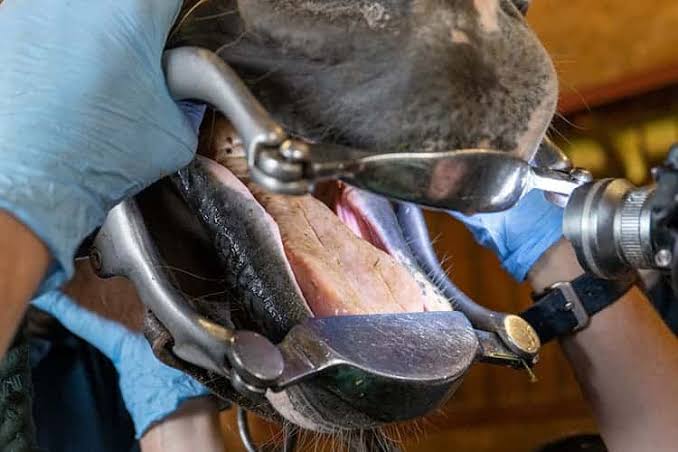
The veterinarian will generally evaluate the horse’s overall condition and examine the jaw and surrounding structures. For a complete examination of the cheek teeth, horses are commonly sedated and fitted with a device called a full-mouth speculum. The speculum gently holds the mouth open so the practitioner can inspect areas that would otherwise be difficult or impossible to see.
A bright light, dental mirror, or oral camera may be used to inspect individual teeth.
Veterinarians may also use radiographs or other diagnostic imaging when they suspect fractured teeth, tooth-root infections, impacted teeth, sinus involvement, or other conditions that cannot be fully evaluated visually.
Once the examination is complete, the veterinarian can determine whether floating or another procedure is necessary.
How Often Should a Horse Have Its Teeth Checked?
Many adult horses should receive a dental examination approximately once a year. However, there is no single schedule that is appropriate for every horse.
Young horses between approximately two and five years of age experience substantial dental changes as permanent teeth erupt. They may benefit from more frequent examinations.
Senior horses may also require more frequent monitoring because missing teeth, periodontal disease, and declining chewing efficiency become more common with age.
A veterinarian may recommend an examination every six months for certain horses, while others with stable dental health may remain on an annual schedule.
Equine Dentistry and Overall Health
Dental care should be viewed as part of a larger preventive health program rather than an isolated procedure. Nutrition, age, previous dental problems, training, and general medical history can all influence a horse’s dental needs.
A horse with comfortable, functional teeth is better equipped to grind forage efficiently and maintain appropriate body condition. Regular examinations can also identify developing abnormalities before they become severe enough to cause significant pain or interfere with eating.
Working with a veterinarian to establish an appropriate dental schedule can therefore contribute significantly to a horse’s comfort and long-term quality of life.
Frequently Asked Questions About Horse Dentistry
How often should a horse have its teeth floated?
There is no universal schedule. Many horses receive a dental examination annually, but floating should only be performed when the examination shows that it is needed. Young, senior, or problem-prone horses may require more frequent care.
Does floating a horse’s teeth hurt?
Proper floating is intended to remove problematic sharp areas of the tooth rather than sensitive internal structures. Horses are commonly sedated during detailed dental examinations and procedures to reduce stress and allow the veterinarian to work safely and accurately.
What age should a horse first see a dentist?
Dental development begins very early, and young horses should have their mouths evaluated as part of routine veterinary care. Dental examinations become particularly important between approximately two and five years of age as permanent teeth erupt.
What happens if a horse’s teeth are never floated?
Some horses develop significant sharp points or uneven wear, while others develop abnormalities more slowly. Untreated problems can eventually contribute to mouth injuries, difficulty chewing, periodontal disease, discomfort, or weight loss.
Can dental problems cause a horse to lose weight?
Yes. Painful or inefficient teeth can make it harder for a horse to properly chew and process feed. Dental disease should therefore be considered when a horse begins losing weight without an obvious explanation.
Why does my horse drop hay while eating?
Dropping partially chewed balls of forage is known as quidding. Dental discomfort or reduced chewing ability is one possible cause and warrants a veterinary dental examination, particularly in older horses.
Do older horses need more dental care?
Often, yes. Senior horses may have missing or worn teeth and may develop periodontal problems or difficulty chewing long-stem forage. More frequent dental monitoring and dietary adjustments may be necessary.
Can horse dental problems affect riding behavior?
They can. Sharp teeth, mouth sores, damaged teeth, or other painful conditions may contribute to head tossing, resistance to the bite, difficulty turning, or changes in behavior under saddle. Because these behaviors can have many causes, a complete evaluation is important.
Questions and Answers provided by Arizona Mobile Vet, an Equine Dentistry Provider in Arizona
